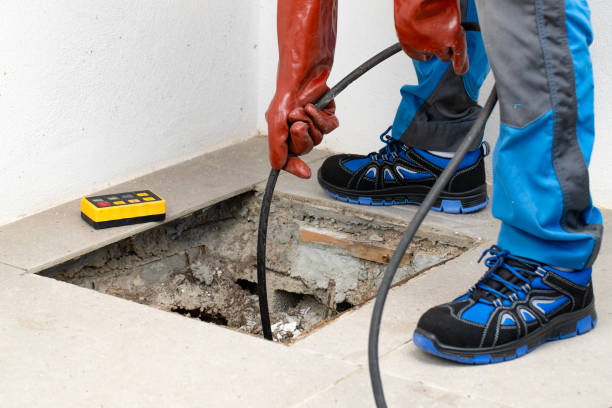
Traditional motorized drain snakes are fantastic for retrieving hair clogs or cutting through minor tree roots. However, if your home’s plumbing is severely choked by years of hardened cooking grease, heavy soap scum, or thick mud sludge, a snake will simply poke a small hole through the muck. The water might drain for a few days, but the sludge will quickly collapse and close the hole back up. For these stubborn, recurring blockages, you need absolute power. We are Roaring Spring, PA’s premier experts in advanced hydrojet drain cleaning. We use industrial-grade, high-pressure water technology to completely obliterate heavy buildup, restoring your pipes to factory-new condition.
When you request our hydrojet drain cleaning service, we deploy a highly specialized machine that acts like a pressure washer for the inside of your plumbing. We feed a flexible, high-pressure hose deep into your heavily clogged sewer or kitchen line. Attached to the end is a specialized nozzle that blasts water at up to 4,000 PSI in a 360-degree, reverse-spray pattern.
The kitchen sink line is typically the most abused pipe in any home. Even if you are careful, microscopic amounts of oils, fats, and grease (FOG) wash down the drain daily. When this warm liquid grease hits the cold pipes beneath your house, it congeals into a rock-hard white paste. Hydrojetting is the only scientifically effective way to completely wash and remove this hardened FOG buildup from your residential plumbing lines without digging up your floors to replace the pipe.
If you live in an older home with original cast-iron plumbing, the inside of your pipes look like jagged, rusty coral reefs. This "scale" constantly snags toilet paper and causes repetitive backups. Our technicians use high-pressure hydrojetting to safely grind and blast that jagged rust away. We smooth the interior of the cast-iron pipe, significantly extending its lifespan and preventing future clogs without requiring an expensive pipe replacement.
"We had a recurring backup issue in our kitchen for months. They came out, ran the hydrojet drain cleaning machine, and blasted years of solid white grease completely out of the pipe. It flows like a brand-new house now."
"My old cast-iron pipes were backing up every few weeks. They used their heavy-duty hydrojetter to descale the rust and wash the line completely clean. Best plumbing service I have ever hired. Honest and very effective."
"A massive grease and root ball blocked our main sewer line on a Saturday. They arrived fast, ran the camera to show me the problem, and hydrojetted it completely clear. I highly recommend them for any tough clogs."
Roaring Spring was established around the Big Spring in Morrison's Cove, a clean and dependable water source vital to the operation of a paper mill. Prior to 1866, when the first paper mill was built, Roaring Spring had been a grist mill hamlet with a country store at the intersection of two rural roads that lead to the mill near the spring. A grist mill, powered by the spring water, had operated at that location since at least the 1760s. After 1867, as the paper mill expanded, surrounding tracts of land were acquired to accommodate housing development for new workers. The formalization of a town plan, however, never occurred. As a result, the seemingly random street pattern of the historic district is the product of hilly topography, a small network of pre-existing country roads that converged near the Big Spring, and the property lines of adjacent tracts that were acquired through the years for community expansion. The arterial streets of the district are now East Main, West Main, Spang and Bloomfield, each of which leads out of the borough to surrounding townships. Two of these streets — Spang and East Main — meet with Church Street at the district's main intersection called "Five Points." The boundaries of the district essentially include those portions of Roaring Spring Borough which had been laid out for development by the early 1920s. This area encompasses 233 acres (0.94 km2) or 55 percent of the borough's area of 421 acres (1.70 km2). Since the district's period of significance extends to 1944, most of those buildings erected after the 1920s were built as infill within the areas already subdivided by the 1920s. In the early 1960s, the borough began to annex sections of adjacent Taylor Township, especially to the east around the then new Rt. 36 Bypass.
Zip Codes in Roaring Spring, PA that we also serve: 16673